

In the past, only smaller ships were used in the marine industry. However, things have changed, as large vessels now transport large amounts of goods. However, these large vessels cannot turn, especially in narrow passages. That’s where the tugboats come in handy. Interestingly, there are different types of tugboats used at sea.
These types differ in size and power. Some boats are used in the harbor to maneuver larger vessels. On the other hand, some types are used in the deep ocean as aids. Remember, these boats can easily tow the larger vessels. In this article, I will discuss all the popular types of tugboats. So, let’s get started!
Overview of Tugboats
Before discussing types, let’s first learn about the basics of tugboats.
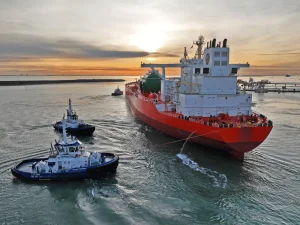
Tugboats are small and compact ships, but with excellent power. They are used to tow, pull, or push the large vessels and navigate them safely through narrow channels. They are equipped with powerful diesel engines that give these small boats their pulling power. These tugboats are commonly used at harbors and ports to ensure vessels pass through tight channels safely.
Large ships or vessels have a higher capacity. They can safely transport heavy-duty materials and goods. However, due to their weight, they cannot maneuver or turn easily. That’s why tugboats are used to ensure these vessels move safely through the channels. Interestingly, tugboats range in size from 15 to 40 meters.
However, they can easily tow vessels that are 10 to 60 times their size. Why? This is because of their strong engines. As I said earlier, the tugboats have strong diesel engines. They give these boats exceptional pulling power, allowing them to pull the vessel easily. Despite their smaller size, these boats are essential for safely docking large vessels.
Here are some key components of tugboats:
- strong hull
- Towing hooks
- Towing winches
- Propulsion systems
- Towing lines or ropes
The tugboat positions itself close to the large vessel depending on the type of operation. Remember, it can both push and pull the large vessel depending on the task. During pulling, the tugboat is connected to the large vessel through towing lines. The tugboat then pulls the large vessel, with its powerful engines providing the power. It can even help push or pull large cargo vessels, which are many times heavier than tugboats.
Types of Tugboats
As I said earlier, there are various types of tugboats. They differ in size and use cases. For example, some tugboats are ideal for use in the deep ocean. Similarly, many of them are preferred in ports and harbors for assisting ships as they prepare to dock. In the section below, I will discuss all those types of tugboats:
1- Harbor Tugboats
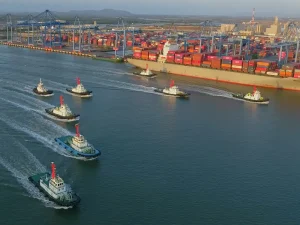
As the name indicates, these tugboats are used at the harbor. The primary role is to assist ships and vessels in docking safely at the docking structure. The size of a harbor tugboat is generally smaller. Why? This is because they are designed to help ships pass through the tight channels. So, their smaller size helps in tight maneuvering.
The engine of harbor tugboats is very powerful, allowing them to tow heavy-duty vessels with ease. It is worth noting that these tugboats have a lower fuel capacity. That’s because they are used only for shorter distance operations and remain near the port. So they can be refueled quickly. For safety, harbor tugboats are equipped with para-lamas de borracha. This helps them stay safe in the event of an accidental collision with either ship or a docking structure.
2- Ocean-Going Tugboats
Ocean-going tugboats are larger in size than harbor tugboats. They are used in the ocean and can travel long distances on a single tank of fuel. This means they can easily tow large ships and vessels over long distances. Generally, their use is widespread in rescue missions. Imagine a vessel is damaged and stranded at sea.
In such a case, the ocean-going tugboats come in handy. They tow the large vessel to the port with ease. Remember, their fuel tank is huge, allowing them to travel farther on a single fueling. These tugboats have dedicated crew compartments. Additionally, they are very durable and can remain in the ocean for a few days, even in bad weather.
3- Coastal Tugboats
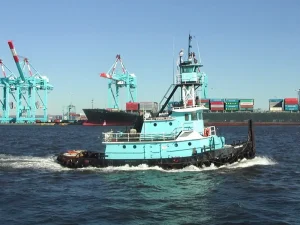
Coastal and harbor tugboats are often misunderstood. Many people consider them the same, which is wrong. Coastal tugboats are used between ports and remain on the coastlines. They help move different barges and assist coastal vessels. Remember, they are used outside of the port. On the other hand, harbor tugboats are used inside the ports and help ships dock.
The engines of coastal tugboats are more powerful than those of harbor tugboats, and their size is also medium. Most coastal tugboats have space for crew members. When it comes to fuel tank capacity, it is higher than that of harbor tugboats but lower than that of ocean-going tugboats. It is noteworthy that these coastal tugboats always remain near the shore in shallow water.
4- Salvage Tugboats
Salvage tugboats are larger and generally used for rescue operations. As you know, the large vessels in the ocean are never 100% safe. They may face various accidents and require immediate rescue or assistance. The salvage tugboats have onboard safety tools, firefighting, and dewatering systems.
These boats are strong and durable and can travel at high speed in the open sea. Additionally, the engines of these tugboats are very robust. They can keep working continuously for hours. These salvage tugboats also have dedicated crew spaces. Additionally, modern salvage tugboats are equipped with all the modern safety equipment. This ensures that these boats perform well during rescue missions.
5- Firefighting Tugboat
These tugboats specialize in firefighting operations. As you know, oil transportation happens through the ocean. The large vessels carry oil in tanks and transport it from one country to another. However, these tankers can sometimes catch fire due to accidents, collisions, or mechanical failures. This can lead to serious consequences and require immediate rescue. The firefighting tugboats are helpful in this case.
These tugboats have large water cannons that spray water from a distance, extinguishing the fire. Remember, these tugboats can be used both at sea and at the ports. Additionally, they can also tow the ship away from the port if it catches fire for any reason. The firefighting tugboats can vary in size and capacity. They are divided into categories according to FiFi standards. In short, these tugboats are considered a must-have for any port to handle emergencies.
6- Escort Tugboats
Escort tugboats are generally used in ports, especially when the vessel moves through the tight channels. As I said earlier, the large ships carry oil and other chemicals. So they must be protected to prevent accidents. The escort tugboat stays alongside the large vessel carrying oil or gas.
If the vessel stops while passing through the channel, the escort tugboat assists it in moving and crossing the channel. Remember, this tugboat is not always engaged, but it remains ready to help. It engages only when the large vessel fails in either steering or propulsion. It matches the vessel’s speed to keep it close and helps when needed.
7- Icebreaking Tugboats
The icebreaking tugboats are used in the winter season. There are many areas where the temperatures go below zero. At these freezing temperatures, ocean water in some regions turns to ice. The vessels or ships cannot move through this ice. In such cases, these icebreaking tugboats are used.
They have a strong, bow-shaped hull, which allows the boat to break through ice. The boat’s weight breaks the ice, creating a path for ships to move. Remember, these tugboats can also be used to tow, push, or move the large vessels. This means they can also be used in icy regions, either at a port or in a harbor, to break the ice.
8- River Tugboats
The river tugboats are smaller, and their engines are not very powerful. They are used in rivers to push small ships to the riverbank for loading and unloading cargo. Their use for moving barges is widespread. The structure of these tugboats is different from that of other conventional tugboats discussed above. They remain in shallow water and are lower in profile. So, they can easily push the vessel from behind and bring it to the right spot. Additionally, the fuel tank capacity of these tugboats is generally lower than that of other types.
9- Tractor & Z-Drive Tugboats
Tractor and Z-drive tugboats are very popular. You’ll see them on almost every modern port or harbor. The tractor tugboats have a propulsion system at the front. This propulsion system allows the boat to steer with precision. On the other hand, the Z-drive tugboat is unique for its Z-shaped propulsion system.
These propellers rotate 360 degrees, allowing the tugboat to move in different directions. So moving it to the right or left and getting a turn becomes a lot easier. These two tugboats differ in their propulsion systems. The primary purpose of these tugboats is the same, i.e., to assist the movement of the large vessels.
Conclusão
In conclusion, tugboats are very important to the maritime industry. Without them, the maneuvering of large ships and vessels will be very challenging. Interestingly, each marine operation requires a different type of tugboat. For example, a rescue operation at sea requires durable, powerful tugboats. On the other hand, river tugboats perform excellently when it comes to maneuvering the small ships in the shallow water. Each tugboat has its unique properties and added value. In this article, I discussed the nine most popular tugboat types that are widely used in the marine industry.