Cryogenic LNG Hose Description

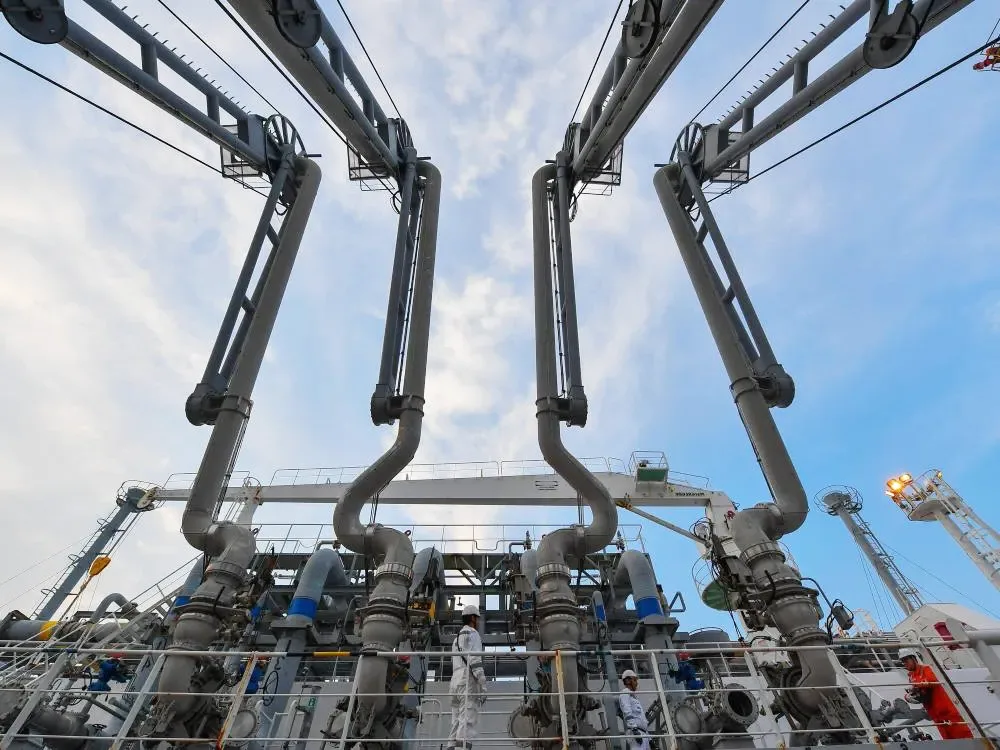
Cryogenic LNG hose is a flexible conduit used to transport liquefied natural gas. It’s typically not used alone but rather integrated into a complete transport system. Common applications include ship-to-ship bunkering and shore-to-ship loading/unloading connections.

The difference between this type of hose and an ordinary industrial hose is that it operates in extremely low-temperature environments. LNG itself has an extremely low temperature; if the materials are not properly selected, the hose will gradually harden over time and may even develop microcracks. This problem may not be noticeable initially, but it becomes quite troublesome over time.

In actual projects, an LNG hose acts more like a “connector.” It doesn’t handle long-distance transport; rather, it solves the transition problem between two devices, such as between ships or between a ship and shore. Using rigid hoses for this transition would be difficult; hence, flexible conduits are used.

Een offerte aanvragen
Cryogenic-LNG-Hose-Description

Structure Of the Cryogenic LNG Hose

LNG hoses are not made of a single layer of material; they are generally multi-layered structures.

  • The innermost layer is in direct contact with the LNG. This area requires high-quality materials, not for strength, but for maintaining their condition at low temperatures. If this layer is not well-made, it will harden over time.
  • The middle layer is a reinforcing layer, and its main function is to withstand internal pressure. In practical applications, the pressure inside the hose will fluctuate; the main function of this layer is to “support” the overall structure, thereby preventing the hose from deforming.
  • The outer layer is the protective layer. In field use, it’s impossible to always operate in an ideal environment; sometimes it’s dragged on deck, and sometimes it comes into contact with other equipment. This layer mainly provides abrasion protection and protection against environmental influences.

These layers together constitute a complete LNG hood. Looking at any single layer is not very meaningful; the key is the assembly’s overall state.

Een offerte aanvragen

How Jerryborg Marine Designs LNG Hoses for Different Applications

Jerryborg Marine prioritizes the end-use scenario of its customers’ LNG hoses. We can recommend specific hose specifications based on the customer’s actual usage needs.

Some projects involve the use of two ships. In these cases, the piping will shift with the location during use, so it cannot be too rigid.

Others involve shore-based connections, which are essentially fixed, prioritizing overall stability.

Furthermore, some are in offshore installations, where the middle section is more susceptible to environmental influences, requiring greater attention to the durability of the outer layer.

The structure is designed according to this approach. It’s not about how thick a fixed layer should be, but rather how that section will be used on-site.

In areas with many bends, the structure won’t be too rigid; in areas with less movement, the pressure-bearing components will be made more stable.

We usually confirm the details of the connection interfaces in advance during the design phase. Many problems encountered by customers during on-site operations are often not due to quality defects in the hose itself. Unsuccessful interface connections can force customers to make repeated adjustments. If these connection details can be determined and optimized early in design, problems that may occur during use can be greatly avoided.

Een offerte aanvragen

Application Scenarios for Cryogenic LNG Hoses

Ship-to-ship Bunkering: The positions between the two ships are not fixed. During docking, the approximate positions are first aligned, and then a hose is used to connect the intermediate section.

Shore-to-Ship Loading and Unloading: The hoselines on shore are fixed, but the ship’s position may change. The final section requires some adjustment space; otherwise, docking will be difficult.

Connections Requiring Repeated Assembly and Disassembly: Some projects are not completed and then left in place, but require multiple connections and disassemblies. Hoses are more convenient in these situations, eliminating the need for repositioning each time.

Locations with Limited Space: For example, where the spacing between equipment is small, or the angle is unsuitable. Rigid hoses are difficult to install in one go; hoses are more suitable for these locations.

Used as Intermediate Transition Sections: In the entire transport system, most of the hoses are fixed; only a small section in the middle uses hoses for transition, primarily to solve the connection problem.

Een offerte aanvragen
Application-Scenarios-for-LNG-Hoses

FAQs

In the field, the positions of the equipment on both sides are usually determined first; the hoses aren’t installed immediately. Once the positions are roughly finalized, a flexible hose is used to connect the middle section, making adjustments easier.

During initial communication, Jerryborg Marine usually understands how this section will be used, such as whether it requires frequent disassembly and reassembly, or how much its location changes. Then they consider the length and structure for smoother operation.

They are usually used in connection sections between two devices, such as ship-to-ship or ship-to-shore connections. Rigid hoses are inconvenient for this section, so flexible hoses are used for the transition.

Jerryborg Marine adjusts the length and interface type during the design process to match the actual connection location, making this section easier to connect on-site.

There is no fixed standard for length; it mainly depends on the project layout. However, increasing the length will change the structural requirements, including increased self-weight and stress.

Jerryborg Marine generally determines the length after confirming the layout and, at the same time, considers whether structural adjustments are needed rather than simply lengthening it.

Mainly bending and stress conditions. Avoid prolonged exposure of any section to extreme conditions, such as excessive bending or excessive stress on one side, as these will affect the service life.

Jerryborg Marine will also provide basic usage suggestions based on the project situation upon delivery, making it easier to control these issues on-site.

Whether replacement is needed depends mainly on the usage conditions, such as usage frequency, environment, and daily conditions. If the usage conditions are relatively stable, it can be used for a longer period.

Jerryborg Marine generally recommends determining replacement based on on-site inspections rather than simply replacing it by time.

Yes, projects generally don’t use just a single hose; rather, it’s part of a complete connected system.

Jerryborg Marine can confirm the interfaces and connection methods in advance, making the overall system easier to integrate, rather than providing a separate hose.