


Mooring buoys are essential tools in the marine industry. They help secure ships and vessels at sea. However, steel mooring buoys can get rusty due to exposure to salty environments. The constant contact with salt water causes rust. This article is about ISO12944 C4H, which helps protect steel mooring buoys from rusting.
ISO 12944 is an international standard developed by ISO. It provides guidelines and helps keep the steel parts of the mooring protected from rust. However, many people consider ISO12944 and C4H the same, which is wrong. In this article, I will cover ISO 12944 and how it helps keep steel mooring buoys safe.
Overview of ISO12944 Standard & Mooring Buoys

First, ISO 12944 is an international standard. C4H is a series under this standard.
ISO 12944 is an international standard developed by ISO. This standard provides a framework and guidelines for protecting steel structures from rusting. These guidelines help protect the steel structure by using a protective paint or coating system. This way, the steel parts are coated and don’t rust over time. Parts that follow ISO12944 resist rusting, even in corrosive conditions.
This standard guides engineers when they make steel structure parts. They understand different aspects using these standards. These include:
- Which protective coating is best for any product?
- How should part surfaces be prepared for the best rust protection?
- What durability level does a part need to withstand given conditions?
These standards guide just a few aspects. Engineers understand these aspects and the framework. After that, engineers decide what needs to be done to make parts rust-resistant. They choose the right coating system for specific environmental conditions. As a result, parts, whatever they are (mooring buoys), become protected against rust.
Mooring buoys are floating devices installed in the ocean. They help ships and large vessels navigate and stay secure. These buoys have anchors that connect to the seabed. This keeps the mooring buoy firmly in place. Ships and vessels moor to these buoys and stay in specific locations for longer periods.
Ships secured to mooring buoys do not move or drift away. Steel mooring buoys have many steel parts. These parts are exposed to salty water and extreme conditions. That’s why manufacturers use ISO 12944 standards to make these parts. They use the right framework and guidelines to make mooring buoy steel parts rust-resistant.
Meaning of C4 and H
ISO 12944 is a standard that offers a separate category known as corrosivity. This corrosivity category “C” indicates how corrosive the environment is where the parts will be used. As you know, different environments have different corrosivity levels. In some environments, the corrosivity is low. So parts in these environments are less likely to get rusty.
In contrast, some environments are highly corrosive. In these environments, steel parts are more likely to get rusty. ISO 12944 categorizes environments based on corrosivity. This table shows the corrosivity level of different environments. Below is the table showing different environments and their corrosivity levels:
| Environment Category | Corrosivity |
| C1 | Très faible |
| C2 | Faible |
| C3 | Moyen |
| C4 | Haut |
| C5 | Très élevé |
| CX | Offshore |
H in C4H represents high durability for a protective coating system. Now understand all the standards together. ISO12944 C4H provides a framework for protecting steel structures from rust. How? Because it uses a higher-durability protective coating system. It won’t rust in highly corrosive environments.
Manufacturers use ISO12944 C4H when making steel mooring buoys. This standard helps them use a specific high-durability protective coating. The coating ensures steel mooring buoys resist rust in highly corrosive environments. ISO12944 C4H is widely used for steel mooring buoy components.
How Our Steel Mooring Buoy Also Achieves ISO12944 C4H Level Rust Protection
At Jerryborgmarine, we offer high-quality steel mooring buoys that comply with ISO12944 C4H. We use a high-quality protective coating system to keep our buoys rust-free. Since they comply with ISO12944 C4H, they have a high-durability protective coating system. This coating system protects steel mooring buoys in a highly corrosive environment.
Below is an explanation of how our steel buoys are made to follow ISO12944 C4H:
1- Steel Surface Preparation
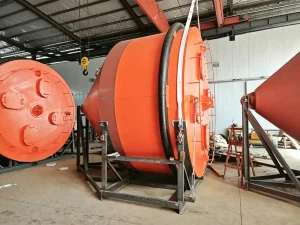
The first step we take to achieve ISO 12944 C4H-level rust protection is surface preparation. As you know, steel can develop rust, mill scale, and other contaminants. These contaminants must be removed before applying the protective coating. If the steel remains uncleaned, the coating won’t adhere properly. Therefore, we use different methods for cleaning the steel surface. Our team also removes grease, oil, dirt, and existing coatings, not just rust. This ensures the paint coating sticks to the steel surface and stays there for a long time.
2- Multi-Layer Protective Coating System
Once the steel surface is prepared, the next step is to apply a coating. We apply multiple coatings to the steel surface. Why? This makes steel mooring buoys highly durable against a wide range of elements. They do not rust, even in extreme conditions. First, we apply primer to the cleaned surface. This primer sticks and bonds well to the cleaned steel surface. Next, the intermediate coat builds thickness in the coating. Lastly, we apply the topcoat, which protects against moisture and salt. The coating then cures and dries, permanently attaching to the steel surface. This way, the steel surface is protected by a coating with protective barriers.
3- Adequate Coating Thickness
After applying multiple coats, we check the dry film thickness (DFT). For this purpose, our team uses a DFT gauge or meter to measure the exact thickness of the coating we applied. Remember, coatings that are too thin or too thick are bad. Therefore, our team applies the coating with care. If the coating is thin, it won’t provide enough resistance against moisture. As a result, the steel part may get rusty. In contrast, thicker coatings can also be bad because they can crack over time. That’s why we apply coatings with a moderate DFT, as measured by a gauge.
4- High-Durability Coating Selection & Quality Assurance
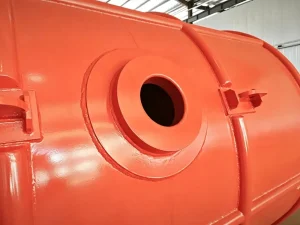
Choosing the right protective coating is critical. A small mistake at this step can cause the steel to rust. Steel mooring buoys won’t comply with ISO 12944 C4H standards. At Jerryborgmarine, we follow ISO 12944 C4H guidelines when selecting a coating system. Our team ensures we choose coating materials that fulfill two criteria:
- First, the coating material is of high durability
- Secondly, this coating material can withstand a highly corrosive environment.
This coating system performs excellently on steel mooring buoys. Remember, this coating only works for steel buoys used in highly corrosive environments (C4 category). Do not use these buoys in the C5 category. Remember, different coating materials are available on the market. Some of these are as follows:
- Epoxy
- Polyurethane (PU)
- Zinc-rich epoxy
- Polyaspartic
- Zinc silicate
- Polyvinyl chloride (PVC)
Our team carefully chooses coating materials to achieve ISO 12944 C4H-level rust protection. These coating materials fulfill specific criteria, which are as follows:
- Withstand moisture
- Resistant to salt spray
- Resistant to humidity
After applying the coatings, we also put our steel mooring buoys through our quality assurance system. Quality control teams check the coating for different parameters. These include curing quality, cracks, adhesion, and any prominent defects. This process ensures better quality of our steel mooring buoys. Steel mooring buoys that pass this check are approved for use.
Does C4H Mean “Thicker Paint”?
No. C4H does not refer to thicker coating. Many people believe C4H is all about coating thickness. As I said above, C4 indicates the environment category. As per ISO 12944, environments are categorized based on corrosivity. Some environments are more corrosive than others. C1 refers to a low-corrosivity environment.
In contrast, C5 indicates a very highly corrosive environment. C4 refers to an environment that is “High” in terms of corrosivity. The parts that are ISO12944 C4H compliant resist rust in a highly corrosive environment. Additionally, H refers to the coating system’s high durability. This does not refer to coating thickness.
Benefits of C4H Corrosion Protection for Steel Mooring Buoys
Steel mooring buoys that comply with ISO 12944 C4H are of the highest quality. They offer better durability and longevity than buoys that don’t meet this standard. Below are some key benefits of C4H corrosion protection for steel mooring buoys:
- First, the C4H system involves applying multiple coatings to the steel surface. These coatings protect the steel mooring buoys from corrosion. Even in harsh conditions, these parts remain protected from rust.
- Maintenance of steel mooring buoys can be a headache, right? However, buoys with a C4H system don’t require maintenance as often. That’s because their coating systems keep them protected.
- Corrosion and rust can be devastating for steel mooring buoys. As you know, buoys are directly in contact with salty water. As a result, they are more likely to rust and deteriorate. But the C4H system protects them from rusting and improves their lifespan.
- Steel mooring buoys without a protective coating become rusty. This affects the visual appeal of these steel structures. However, with the C4H system, the steel parts of mooring buoys maintain their appearance. They don’t get rusty or corrode quickly, which is an advantage.
Conclusion
In conclusion, the ISO 12944 C4H standard is very important for different steel structure parts. Using steel mooring buoys to improve durability is becoming common. In fact, buyers now also prefer those buoys that comply with ISO12944 C4H.
At Jerryborgmarine, our steel mooring buoys also meet this rust-protection level. That’s why these buoys last for years without getting corroded. In fact, you can use our steel mooring buoys in the harshest conditions. In this article, I have discussed everything about the ISO12944 C4H standard. You’ll also learn how we achieve ISO 12944 C4H-level rust protection.